
- 15 January 2026
- Posted by: nemcatgroup
- Category: Publications
No Comments
Scientists working with XRD have limited tools to model intricacies in XRD experiments. Conventional Bragg-Brentano style powder diffractometers have robust in-built software which allow users to simulate powder XRD diffractograms. However, these programs can only account for so many modifications to powder XRD experiments. Thus, there is no all-encompassing software that allows a user to simulate a powder XRD diffractogram from an arbitrary experimental geometry, while also being able to account for all necessary X-ray physics and crystallographic information.
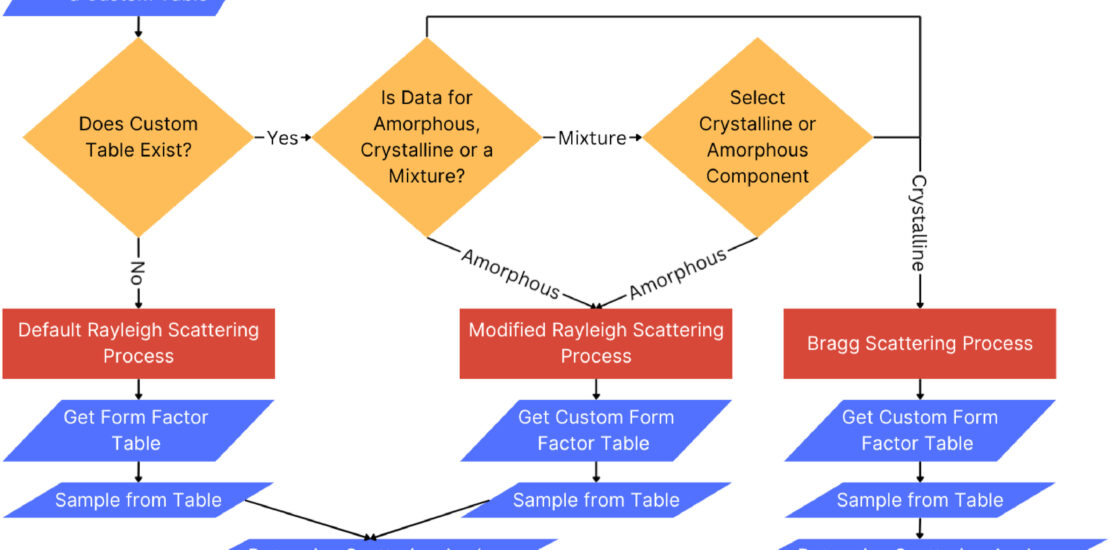
A modification to Geant4 Penelope Rayleigh scattering model has been performed that allows a user to simulate physically accurate coherent elastic scattering (Bragg scattering) from a powdered crystal material. This will enable scientists to simulate XRD experiments, with any geometry, as long as it can be constructed in Geant4 while also accounting for all necessary physics.
To showcase the modification, two Bragg-Brentano style diffractometers (Empyrean I and MiniFlex) have been constructed in Geant4 and were used to produce a simulated diffractogram. The simulations were undertaken with custom generated scattering form factors that account for inherent diffraction peak broadening. These results are compared to experimentally obtained diffractograms, with the analysis revealing a good match. Thus, this showcases the potential for the model to be used in different diverse XRD experiment simulations.