
- 6 August 2026
- Posted by: nemcatgroup
- Category: Publications
No Comments
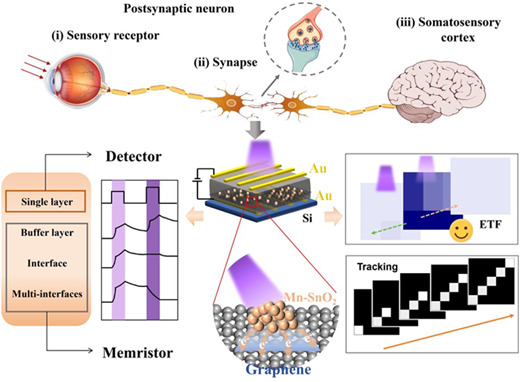
All-optically controlled semiconductor devices are pivotal for next-generation neuromorphic computing and artificial vision, yet these remain challenging due to the difficulty in achieving reversible optical modulation as well as high operational efficiency and stability. Herein, a multidimensional interface structure based on two-dimensional (2D) thin film/oxide quantum dots (QDs) has been designed and fabricated via a flexible solution process. This architecture features a significantly enlarged effective interface area, which dramatically enhances photogenerated carrier separation and interfacial charge injection efficiency. Consequently, fully optically driven reversible operations are realized under ultraviolet light, eliminating the need for electrical stimuli. The device exhibits high sensitivity, excellent nonvolatility, and robust synaptic functions, including “learning–forgetting–relearning” dynamics. Furthermore, an array successfully emulates human visual perception and memory, demonstrating a dynamic response to light intensity and duration. Remarkably, a self-protective optical RESET effect is observed under strong illumination (>1.77 W·cm–2), enabling reversible regulation and safeguarding against data anomalies. This work overcomes critical limitations of photoelectric coupling and presents a promising platform for high-efficiency, low-crosstalk neuromorphic vision systems and optically driven robotics.