
- 19 May 2026
- Posted by: nemcatgroup
- Category: Publications
No Comments
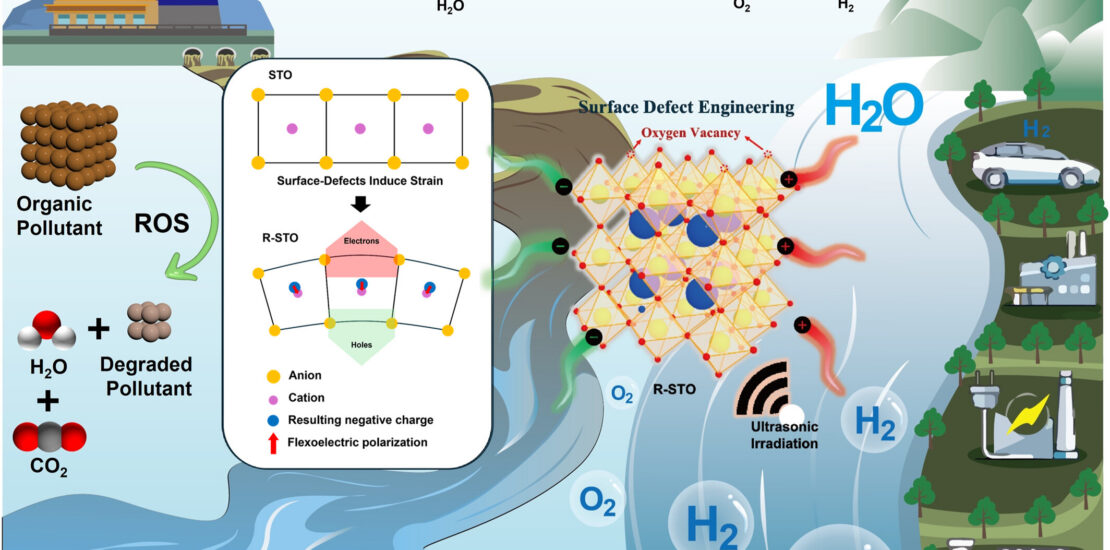
Flexocatalysis provides an alternative route for converting mechanical energy into electrical energy through flexoelectricity, thereby avoiding the crystal-symmetry constraints that limit conventional piezocatalysis to non-centrosymmetric materials. In this study, strong flexocatalytic effects were established in reduced strontium titanate (R-STO) nanoparticles prepared by a facile solid-state reduction route. Regulated generation of oxygen vacancies generates near-surface lattice distortion and a gradient in lattice strain, which together give rise to substantial flexoelectric polarization, and thus R-STO demonstrates an excellent capability for Rhodamine B (RhB) decomposition, achieving > 78% degradation within 45 min. The kinetic rate constant of R-STO (0.0307 min−1) is nearly double that of pristine STO (0.0163 min−1), primarily due to enhanced charge separation and prolonged electron–hole pair lifetimes induced by the flexoelectric polarization. R-STO also exhibits an impressive co-catalyst-free hydrogen production rate of 380.8 μmol/g/h, representing a fourfold increase over pristine STO (94.5 μmol/g/h). This enhancement is attributed to synergistic effects of improved charge separation and transfer, a favorable band structure, and optimized adsorption configurations during catalysis. These results underscore the promise of flexocatalysis for applications in environmental remediation and renewable energy production.