
- 4 March 2026
- Posted by: nemcatgroup
- Category: News
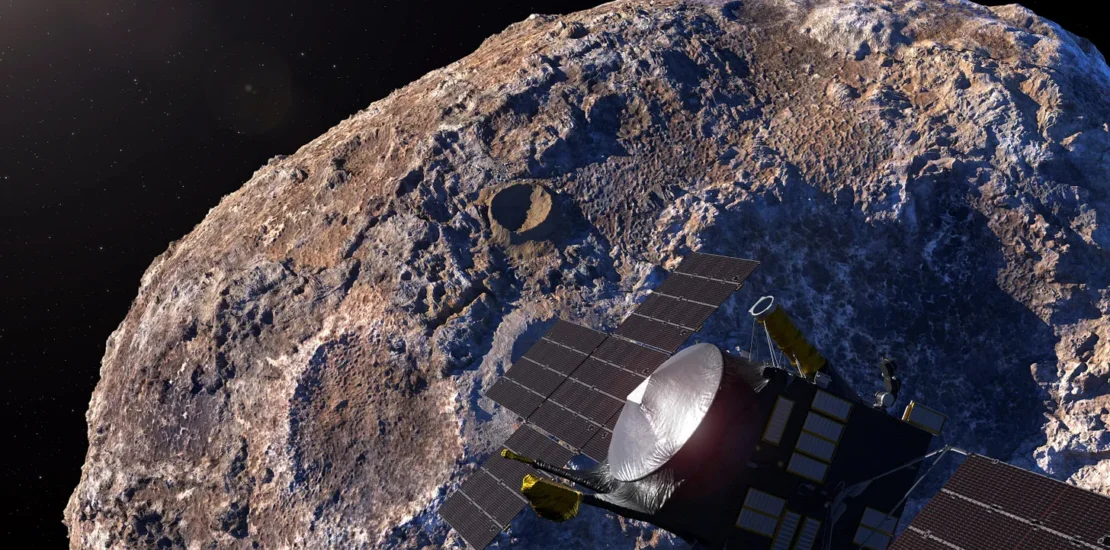
The pitch is simple: launch a rocket into space, land on a rock, scoop out trillions of dollars worth of critical minerals, and retire Earth’s environmental problems forever.
The reality, unfortunately, is a tad less cinematic.
It’s one of those potential scientific breakthroughs that’s been floating around for a while but has remained tantalisingly out of reach.
That’s because, as it turns out, space is a tricky place to operate.
Because there’s no gravity, even basic processes—drilling, crushing, and separating materials—become complex physics problems.
That’s the eye-wateringly expensive puzzle asteroid-mining companies are trying to solve.
But fear not, this sci-fi dream hasn’t died, it’s just slowed down a bit while we hunt for better tools, better data, and a better grasp of what’s drifting through space!
We asked Marcus Miljak, a PhD candidate in the UNSW School of Materials Science and Engineering, for his thoughts on asteroid mining.
He’s working on tools to help us better analyse off-world minerals.
Asteroid mining sounds like the works of science fiction, is it actually possible?
I definitely think it is.
Right now, researchers around the world are developing sensing vehicles: autonomous robots that can roam across asteroids or the Moon, collect samples, and analyse them on the spot!
In fact, most countries are working on their own little portable, space-faring asteroid analyser—like a Lunar Rover.
Australia has one (called the “Roo-ver”), even India has tried to launch one.
Each rover is equipped with different sensors or analytical tools that scientists think will be useful for understanding what’s on the surface of these celestial bodies.

Why even bother mining asteroids?
There are several really valuable resources you can get from space, the first one being water.
If you can find water on an asteroid, you can break it down into hydrogen and oxygen using electricity generated from a solar panel.
Suddenly you have rocket fuel, which you can then burn as propellant to produce thrust.
With this, you could potentially create spacecraft that can travel indefinitely, as long as there is sunlight for some solar panels.
This is how it would work in theory: send a spacecraft from Earth, have it land on an asteroid, collect water, turn it into fuel, survey the area, then hop on to another asteroid and repeat the process.
The whole process wouldn’t even involve humans!
What’s also really interesting is that space has some valuable resources that are super rare on Earth, like helium isotopes on the Moon (used for super low temperature cryogenics).
It might be economically feasible to harvest them and bring them back.
There is also research being done on how asteroids are formed.
We know they are made under extreme conditions, like very high pressures and temperatures that are very difficult to achieve on Earth.
Why haven’t we been able to do it yet?
Well, asteroids have almost no gravity.
You need to develop systems that can harvest extract materials in a zero-gravity environment, which is very difficult, and hard to test on Earth (because gravity is everywhere).
It is also expensive to test these systems in real life, especially with rockets involved.
Another big issue: landing on an asteroid.
These big space rocks have no atmosphere, which makes it tricky to slow down a rocket enough to be able to land on one.
Your work in analysing moon rocks, is that important here?
Well, if you don’t know what an asteroid is made of, it would be quite challenging to mine out of it.
We might even need to test each asteroid before deciding whether it’s worth mining.
This is why I think asteroid characterisation will be a huge part of any future space-mining industry.


What are the chances of it happening in our lifetime?
There’s a lot of work being done right now on rovers and related technologies across the globe.
If space exploration and research continue to grow and receive funding, I don’t see why this couldn’t happen in our lifetime.
That being said, there are social and political factors worldwide that influence how much funding space research receives.
But overall, I’m quietly confident something like this will happen within our lifetime.
Should we be doing it? Or are we just exporting Earth’s problems into outer space?
Given the growing problem of space debris around Earth, there are strong arguments to be made for preserving parts of the solar system before we go ahead and industrialize them.
So if we’re going to do it, we’ll need to do it very carefully and far from the vicinity of the Earth.
However, this also creates cost issues in transporting minerals back to Earth, which is also an important consideration.