
- 11 March 2026
- Posted by: nemcatgroup
- Category: Publications
No Comments
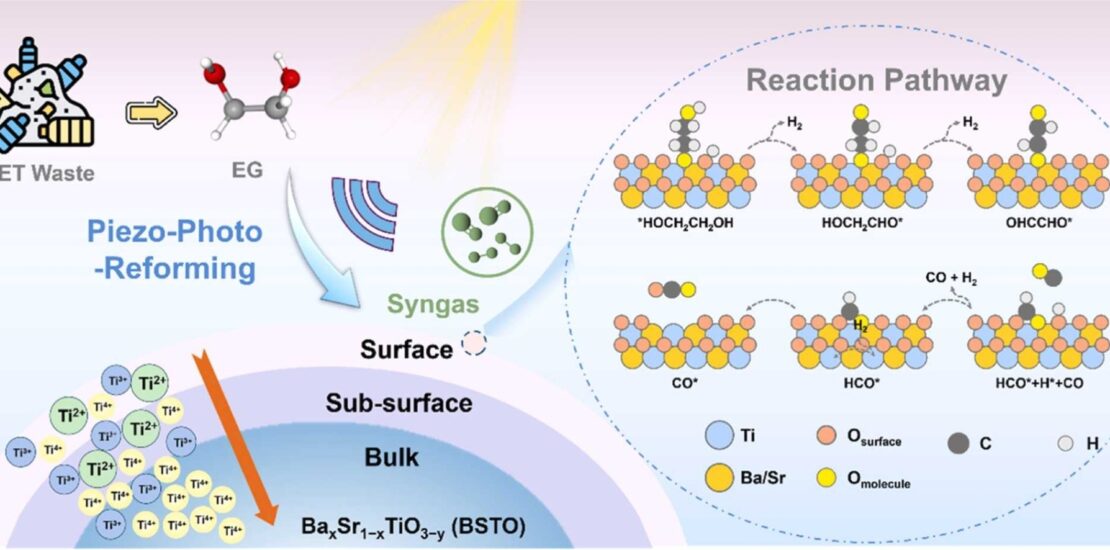
Piezo-photocatalytic upcycling of plastic waste into added-value hydrocarbon fuel leverages mechanical and solar energy to reintegrate end-of-life plastics into the carbon cycle. This work reports a process that converts PET-derived ethylene glycol (EG) into syngas under ambient conditions using defect-engineered BaxSr1−xTiO3−y (BSTO) catalysts. A three-stage process produces graded oxygen-vacancy and Ti3 + surface concentrations. Combination with optimized band structure yields catalysts of strong piezo-photo responses. Photoelectrochemical measurements confirm accelerated light-induced charge separation and transfer, while Kelvin probe force microscopy and DFT simulations corroborate defect-amplified piezoelectric polarization. Using this catalyst, EG solutions derived from PET microplastics and textile fibers demonstrate selective syngas compositions, confirming applicability to real-world PET waste. Mechanistic studies show that piezo-photo-reforming of EG achieves respective H2 and CO evolution rates of 1062 and 646 μmol/g/h, > 90% syngas selectivity, and an H2/CO ratio (∼1.6), representing nearly a 20-fold increase in gas yield over photocatalysis alone. Control experiments demonstrate that catalyst composition and activation govern both catalytic activity and syngas ratio tunability. In situ ATR-FTIR identifies surface formate as a key intermediate, while 1H NMR detects glycolic acid/glycolate in the liquid phase. DFT calculations indicate that lattice-oxygen-assisted C–C bond cleavage is significantly promoted within the reaction pathways.