
- 13 July 2026
- Posted by: nemcatgroup
- Category: Publications
No Comments
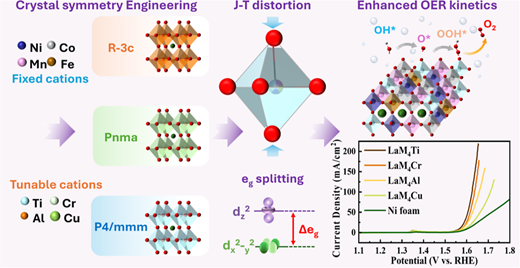
High-entropy oxides (HEOs) offer a vast and largely unexplored design space for electrocatalysis. However, the effect of complex lattice chemistry in governing catalytic activity remains unclear. In this work, we demonstrated a strategy in which manipulating the Jahn–Teller (J–T) distortion is effective in optimizing the oxygen evolution reaction (OER) activity of the lanthanum-based high-entropy perovskite oxides (PHEO). By tailoring the B-site cation chemistries in the perovskite lattice, we stabilized lanthanum-based HEOs with three distinct crystallographic symmetries and directly correlated the observed phase evolution with the degree of J–T distortions. Combined experimental characterization and theoretical calculations reveal that J–T distortion lifts the degeneracy of the eg orbitals, thereby facilitating favorable adsorption energetics of oxygen-containing intermediates and surface electron transfer. As a result, the optimized HEO catalyst renders a low overpotential of 338 mV at 10 mA cm–2 with decent durability over 50 h. This work establishes crystal symmetry and J–T distortion engineering as a powerful and physically meaningful platform for manipulating catalytic functions in high-entropy oxides.